


Registering Children Born Abroad to Israeli Parents: The Complete Guide
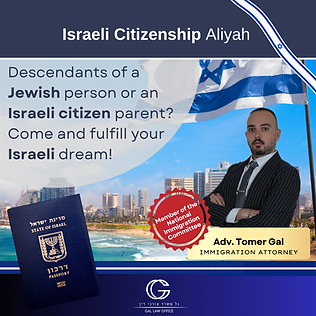
Adv. Tomer Gal - Expert in Israeli Citizenship Law for Israelis Abroad
"A child born outside of Israel to an Israeli parent is an Israeli citizen from the moment of birth. In other words, Israeli citizenship is granted by law, even without formal registration.
However, "without regulating this status in the Population Registry, the legal bond remains dormant and is liable to create significant bureaucratic, legal, and security difficulties in the future," explains Adv. Tomer Gal, a member of the National Immigration and Human Rights Committee of the Israel Bar Association.


Legal & Historical Background: Who is Eligible for Israeli Citizenship?
The Israeli Citizenship Law operates according to the principle of Jus Sanguinis (Latin for "Right of Blood") as the basis for passing on citizenship. This stands in contrast to countries that operate under Jus Soli (Latin for "Right of Soil"), such as the United States, where citizenship is determined by the geographical location of birth. In Israel, citizenship depends on the parents' citizenship and is automatically transferred to the children of an Israeli citizen at the time of birth.
However, citizenship is automatically transferred for only one generation born outside of Israel. Proper registration of this generation is the only way to ensure the continuity of rights and the protection of the family’s legal status in Israel.
Registering Children Born Abroad: A Legal Obligation and Vital Necessity
Israeli law automatically applies citizenship to the children of Israelis born abroad. This means that even if the child has never visited Israel, they are considered a citizen from birth. Consular registration is not an optional "choice," but a legal obligation that must be carried out shortly after birth.
Important to note: Failure to register the child does not cancel their citizenship and does not exempt them from their obligations to the State. On the contrary, it creates a status of an "unregistered citizen," which can lead to severe legal and bureaucratic complications, such as:
1. Regulation of Military Status – Preventing "Desertion"
The obligation to serve in the IDF applies to every citizen regardless of their place of residence or birth, even if they are not registered in the Israeli Population Registry. Without formal registration, the military authorities at the Israeli Consulate abroad are unaware of the child's existence and cannot grant them "Emigrant Status" (which provides an exemption or deferral from service). This can lead to the child being considered a deserter upon reaching age 18, potentially resulting in arrest upon arrival in Israel, even for a brief visit. Early registration establishes the child's status and shifts the burden of responsibility for regulating their military standing to the State, protecting your child from future claims of "evasion."
2. Legal Entry into Israel
By law, an Israeli citizen must enter and exit the country using an Israeli passport only. Entering on a foreign passport without regulating the child’s citizenship leads to delays, questioning, and complications at border control. In some cases, exit from the country may even be blocked until the child's citizenship is fully regulated.
3. Protection of Assets and Inheritance
Continuous civil documentation is a prerequisite for exercising inheritance rights and registering property in Israel. Without proving a registered lineage in the Israeli Population Registry, children may encounter significant legal hurdles in receiving property or rights to which they are lawfully entitled.
4. The Right of Return and State Safety Net
An Israeli passport and registration are a guaranteed "entry ticket" to Israel at any given moment. Unlike foreign residents, a registered citizen can return to Israel immediately without complex bureaucratic procedures. In the event of a natural disaster, political crisis, or emergency in your country of residence, registration ensures rapid evacuation, consular assistance, and a safe return to the homeland.
The Registration Process: From Administrative Track to Judicial Recognition
The registration process is not automatic and involves more than just presenting a birth certificate. The Israeli Ministry of Interior operates under a rigid set of rules designed to verify the authenticity of the family connection. As time passes from the birth, the required level of proof increases to prevent fraudulent citizenship claims.
Therefore, the process is generally divided into two tracks:
1. The Administrative Track: Within a short window-usually the child's first year-registration can be completed administratively at the Consulate. However, a common mistake is thinking a foreign birth certificate (even with an Apostille) is enough. The Consulate often requires a "package of evidence" proving the actual parental relationship and partnership, such as pregnancy records or proof of a shared household.
2. The Judicial Track: In certain cases, especially after one year has passed, the Consulate is not authorized to approve the registration on its own. They will require a Court judgment confirming parentage and Israeli citizenship. This is a full legal proceeding conducted in an Israeli court by lawyers against the State Attorney’s Office. During the process, an Israeli judge may require DNA (tissue typing) evidence. The resulting judgment is the only legal document that can then establish the child's citizenship.
Remember: The burden of proof is on the parents. The State does not assume the report is reliable until proven otherwise by physical or scientific evidence. The later the registration occurs, the higher the evidentiary threshold becomes.
Steps to Register a Child Born Abroad as an Israeli Citizen
Gal & Co. Law Firm, led by Adv. Tomer Gal - a member of the Israel Bar Association's National Immigration Committee, has successfully represented numerous clients in claims against the Israeli Ministry of Interior. Our firm handles cases with a high legal probability of success and guides you through every stage:
-
Eligibility Assessment: Checking the child's eligibility according to Israeli law and the parent's status.
-
Paperwork Preparation: Preparing all necessary documents, Apostilles, and certifications.
-
Legal Representation: Submitting the application to Israeli authorities and, if necessary, representation in Israeli courts.
-
Final Registration: Registering the child in the Population Registry and issuing an Israeli biometric passport.
Proven Experience in Citizenship, Family, and International Law
Legal success in regulating status in Israel through parental inheritance is not just about filling out forms. It is a process that integrates three complex legal disciplines: Israeli Citizenship Law, Family & Personal Status Law, and International Law.
Gal & Co. Law Firm brings extensive field experience and daily involvement at the intersection of these three worlds. We provide our clients with a legal umbrella based on active litigation and extensive public activity:
-
Leading Proceedings against State Authorities: Assertive representation before the Ministry of Interior and the Population and Immigration Authority, and managing complex claims in Family Courts against the Attorney General.
-
Statutory and Public Activity: Adv. Tomer Gal serves as a member of the National Immigration & Human Rights Committee of the National Israel Bar Association, providing a deep understanding of the evolving procedures and policies of the authorities.
-
International Legal Bridge: Practical experience in overseeing citizenship and status proceedings in Europe and Israel. This expertise allows us to seamlessly manage foreign documentation, Apostilles, and cross-border legal solutions tailored to a global reality.
-
Representation in Sensitive Cases: Leading family law proceedings including proof of paternity, DNA testing, and late registrations, requiring both sensitivity and uncompromising professionalism.
Our firm’s approach combines a determined legal strategy with a deep understanding of the unique needs of Israelis living abroad. We know your passport is not just a document - it is the peace of mind for you and your children.
Secure your status today.
Contact us for an eligibility check and professional consultation - Click here


Attorney Tomer Gal is a member of the National Immigration Committee and recognized by official and leading institutions in the field of immigration and law, both in Israel & abroad.